The Reason Matching Seamless Sets Stop Matching After a Few Months
Quick Answer: Matching sets drift out of sync because the bra and the leggings accumulate wear at different rates — most people wear the leggings with other tops far more often than they wear the bra, so the leggings hit twice the wash cycles and fade faster. Washing both pieces together every time, even when only one was worn, keeps them aging at the same pace.
It’s a genuinely fixable problem, and the fix costs nothing. It just requires treating the set as one garment rather than two.

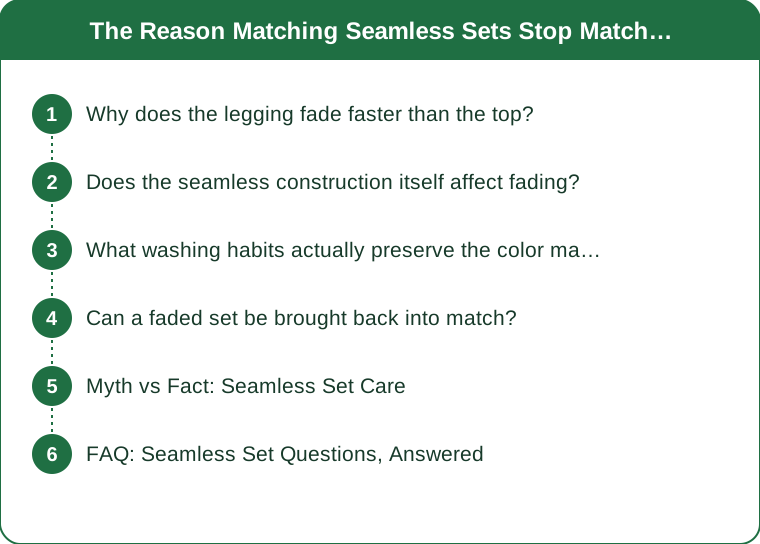
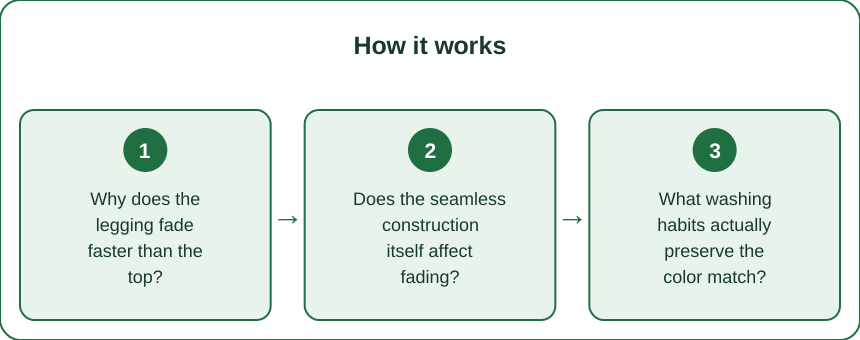
Why does the legging fade faster than the top?
Usage frequency, almost entirely. A seamless legging is a wardrobe workhorse — it gets paired with tees, crops, hoodies, and half the closet. The matching bra usually only comes out when you’re wearing the full set. Over six months, that can easily mean the legging has gone through 40 wash cycles while the bra has gone through 15.
Dye loss is roughly proportional to wash cycles and friction, so a piece with nearly three times the cycles will visibly lighten first. The fabric isn’t lower quality; it’s just done more work.
Does the seamless construction itself affect fading?
It does, and in a way that surprises people. Seamless garments are knitted as a single tube on a circular machine, which means the fabric density varies deliberately across the piece — tighter knit for compression zones, looser knit for breathable zones.
Dye takes differently to different knit densities, so the looser, more open areas release color slightly faster than the dense compression zones. On a ribbed seamless set this can show up as subtle banding after heavy washing. It’s inherent to the construction rather than a defect, but it means seamless pieces reward gentle washing more than flat-knit ones do.
What washing habits actually preserve the color match?
Three things matter most. Wash both pieces together every time, even when only the legging was worn — this is the single highest-impact change and it directly equalizes the cycle count.
Wash cold and inside out. Hot water opens the fiber structure and releases dye far faster; turning pieces inside out keeps the visible surface away from drum friction. And skip fabric softener entirely — it coats synthetic fibers, which both traps odor and dulls color over time. Air-drying rather than machine-drying compounds all three benefits.

Can a faded set be brought back into match?
Partially, and expectations should stay modest. A color-restoring wash or a dye specifically formulated for synthetics can close a small gap, but nylon and elastane blends take dye unevenly compared to cotton, so results are unpredictable — and the compression zones will absorb differently than the open-knit zones.
The more reliable approach is repositioning: once a set has drifted, treat the pieces as separates and pair each with a neutral. A slightly faded legging with a black top reads as intentional, whereas a near-match that’s visibly off reads as worn out. The near-match is the only genuinely bad outcome.
Myth vs Fact: Seamless Set Care
Myth: Seamless fabric is more delicate than flat-knit and needs hand washing. Fact: machine washing cold on a normal cycle is fine — it’s heat and softener that cause damage, not the agitation.
Myth: Washing after every single wear ruins activewear. Fact: sweat left in synthetic fibers degrades elastane faster than washing does. Wash after each real workout; a light-wear day can wait.
Myth: Darker sets don’t fade. Fact: dark colors lose dye at similar rates — the change is just less obvious until the two pieces sit side by side, which is exactly when a set reveals it.
FAQ: Seamless Set Questions, Answered
Should I buy two of the same legging so the set lasts longer?
If the set is one you genuinely wear often, yes — rotating two identical leggings halves the cycle count on each and keeps both closer to the bra’s fade rate.
Do ribbed seamless sets fade faster than smooth ones?
Slightly, because the rib structure alternates dense and open knit, and the open sections release dye a bit faster. The difference is small with cold washing.
Is pilling on seamless fabric a sign of low quality?
Not necessarily — pilling happens at friction points on almost all synthetic knits. Persistent pilling after only a few wears is the real quality signal.
TL;DR:
- Sets drift because leggings get worn and washed far more often than the matching bra
- Wash both pieces together every time to equalize cycle counts
- Cold water, inside out, no fabric softener, air dry — in that order of impact
- Once a set has drifted noticeably, styling each piece with a neutral beats a near-match
The fade isn’t a quality problem so much as a usage-rate problem. Treat the set as a single unit in the laundry and it stays a set far longer.
See It in Motion
Seen here: Super High Waist Embossed Yoga Leggings with Inner Pocket — shop it on bubblelime.com
Keep Reading
This article is for general informational and styling purposes only. Fit, sizing, and product availability may vary.