Why a Seamless Set Needs a Third Piece Once the Weather Turns
Quick Answer: A seamless set works in summer because the two pieces read as one deliberate outfit. Add a random third layer and that reading breaks. The layer that preserves it is either exactly matched in weight and length, or so clearly different that it reads as intentional contrast — anything in between looks like you got cold.
The set was a complete outfit all summer. You put a jacket over it last week and it stopped working.
It is not that the jacket is wrong exactly. It is that the set stopped being the outfit and became underwear for the jacket.
There is a specific reason for that, and a specific fix.

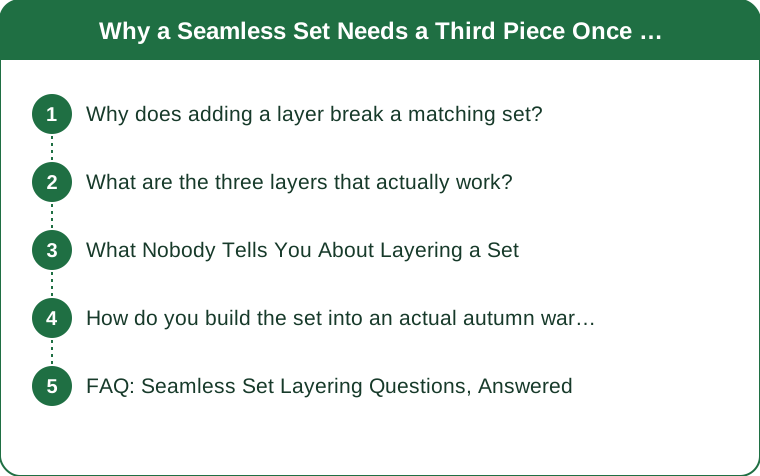
Why does adding a layer break a matching set?
Because a set works by being visually continuous, and most third layers interrupt that continuity at exactly the wrong point.
A seamless set reads as a single garment because the color, texture, and rib pattern run uninterrupted from shoulder to ankle. Your eye follows one line. That is the entire effect, and it is why sets look more considered than separates that happen to match.
A cropped jacket cuts that line at the waist. A mid-length coat cuts it at the hip. Either way, the continuous surface becomes three zones, and the set’s contribution is reduced to two visible fragments.
The layers that work are the ones that either extend the line or clearly frame it. An open long cardigan runs parallel to the set and frames it vertically without cutting across. A cropped layer that ends exactly where the top ends reads as part of the top rather than an interruption.
Everything in between — the mid-length zip-up, the hip-length jacket — is what produces the got-cold look.
What are the three layers that actually work?
The long open layer. A duster cardigan, a longline coat worn open, or an oversized shirt. Length below mid-thigh, worn open, no belt. This is the most reliable option because it adds vertical lines on either side of the set without crossing it anywhere.
The exact-crop layer. A cropped jacket or zip-up whose hem lands within an inch of the set’s top hem. Because the two hems coincide, your eye reads them as one edge and the continuity survives. This one is fussy about length and forgiving about everything else.
The full-contrast layer. A borrowed-looking oversized piece in a completely different texture and color — a chunky knit, a shearling, a heavy overshirt. This works because it is so obviously a separate decision that nobody reads it as an accident. The rule here is that it must be clearly bigger and clearly different; a slightly oversized layer in a similar tone is the worst of both approaches.
What does not work is anything hip-length and fitted in a color adjacent to the set. That is the specific combination that reads as an afterthought.

What Nobody Tells You About Layering a Set
The bottom half needs attention too, and nobody talks about it. A set that is now under a long cardigan has changed proportion at the top, and the footwear that balanced it in summer usually does not anymore.
Sandals or minimal sneakers worked because the outfit was light throughout. Add a substantial layer above and the same shoes leave the outfit top-heavy. A boot or a chunkier sneaker restores the balance, and it is the change people skip.
The second thing: your set will pill faster once you start layering. Friction between the seamless knit and a wool or textured outer layer is significantly more abrasive than skin or air, and it concentrates at the shoulders and upper back. Wearing a smooth-lined layer, or a thin long-sleeve between the set and a wool coat, makes a real difference over a season.
And the practical one — the top of a seamless set is usually the piece that gets worn alone least. Once you start layering, it gets worn under things constantly while the bottoms stay the same, and the two pieces begin aging at different rates. If you care about them matching, wash them together every time regardless of which one you wore.
How do you build the set into an actual autumn wardrobe?
Treat the set as the base layer of an outfit rather than the outfit itself, and choose two third pieces rather than trying to layer whatever is nearest.
One long open layer in a neutral that works with every set you own. This is the workhorse and it will handle roughly three quarters of the situations.
One contrast piece with real texture — the chunky knit or overshirt — for when the neutral reads as too plain. Between those two, most autumn days are covered.
Add a thin long-sleeve base in a matching or complementary tone for genuinely cold days. Worn under the set’s top, it extends the sleeve without breaking the line, which is far better than layering something over.
And resist the temptation to buy a set in a heavier fabric for winter. Seamless sets are a warm-weather construction; the winter version of the same idea is usually a ribbed knit two-piece, which is a different garment with different rules and rarely as good at the one thing sets do well.
FAQ: Seamless Set Layering Questions, Answered
Can I wear the top and bottom separately in autumn?
Yes, and the bottoms separate far more easily than the top. A seamless legging works with anything; a ribbed seamless top worn with unrelated bottoms tends to read as a missing half unless the texture is distinctive enough to stand alone.
What color third layer is safest?
One clearly darker than the set, or a true neutral. Matching the set’s tone approximately is the highest-risk option because near-matches read as mistakes in a way that clear contrasts do not.
Do I need to size the layer up?
Generally yes for the contrast piece and no for the exact-crop one. The long open layer should be your normal size or one up, since it is worn open and its job is the vertical line rather than the fit.
TL;DR:
- A set works because the color and texture run in one continuous line, and most third layers cut that line at the worst point.
- Three layers work: the long open layer, the exact-crop layer, and the full-contrast oversized piece.
- Hip-length and fitted in a near-matching color is the specific combination that looks accidental.
- Rebalance footwear once you add weight up top, and wash both halves together as layering wear diverges.
The set has not become less useful — it has become a base rather than a finished outfit. Choose two deliberate third pieces and it will carry through autumn looking as considered as it did in August.
Keep Reading
This article is for general informational and styling purposes only. Fit, sizing, and product availability may vary.