Buying a Seamless Set in Two Different Sizes Is Usually the Right Call
Quick Answer: Seamless tops and bottoms are engineered for different jobs — the top needs to hold across the chest and shoulders, the bottom needs to hold across the hip and thigh — and very few bodies need identical sizing in both. Because seamless knits have less structural give than sewn garments, a compromise size fits neither piece well. Buying separately when the brand allows it is the fix.
The set looked perfect online. In person the leggings were right and the top was tight across the chest, or the top was right and the leggings sagged at the waist.
You did not choose wrong. You were asked to choose one number for two different problems.
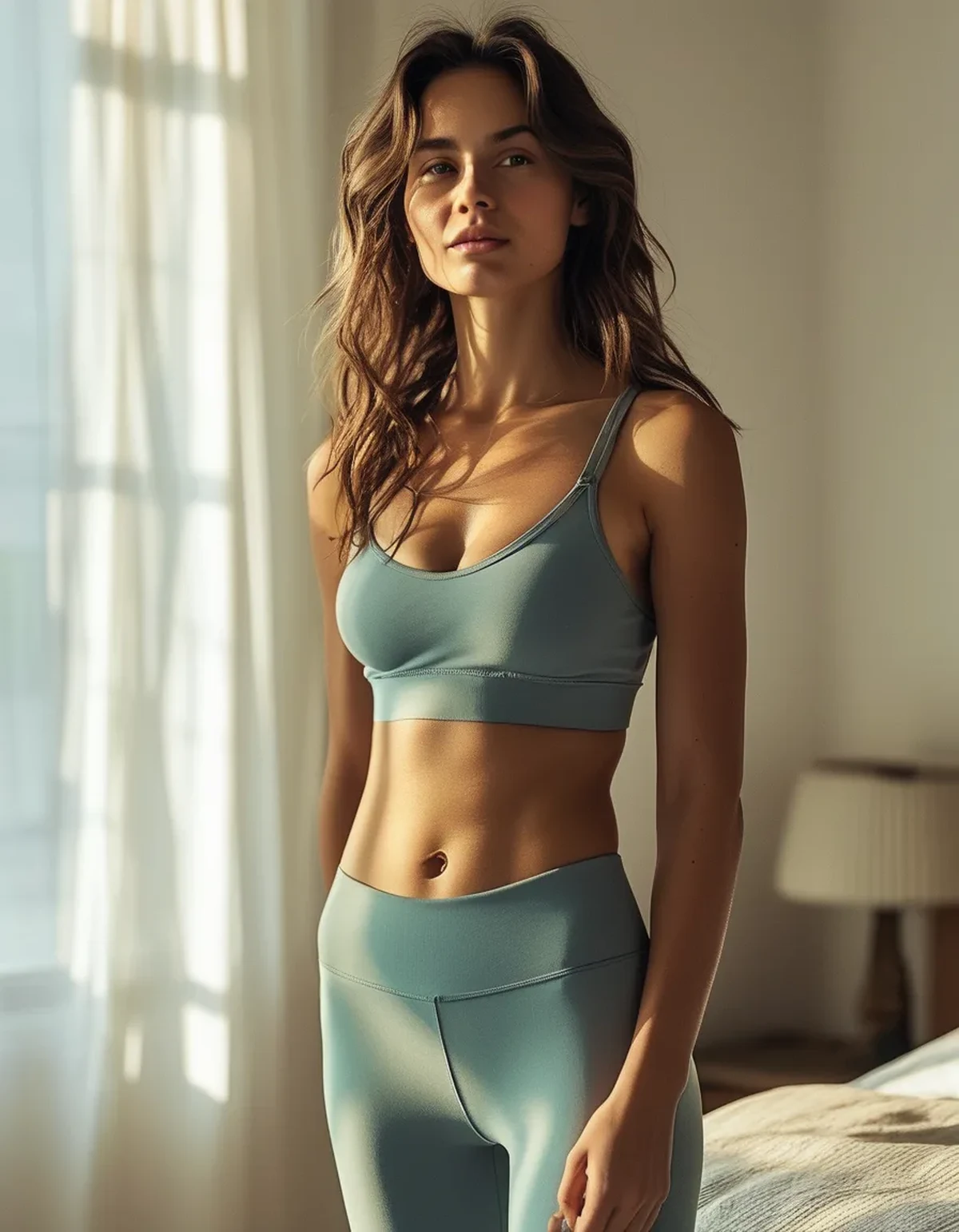
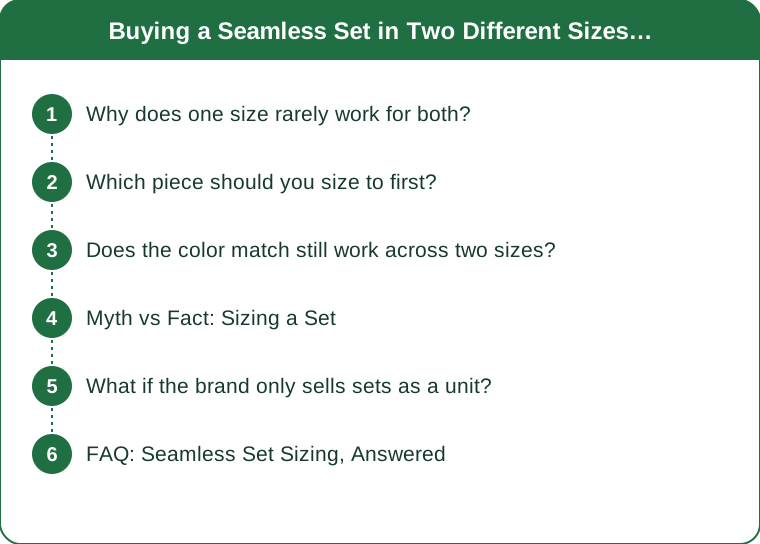
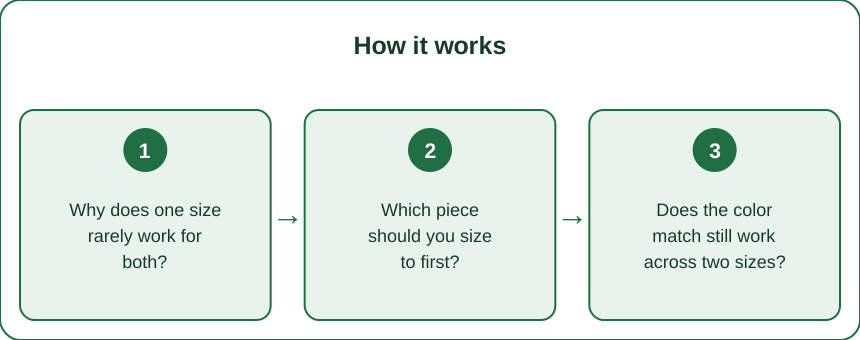
Why does one size rarely work for both?
Because most people are not the same size relative to the sizing chart in both halves.
Activewear size charts are built from a set of body measurements combined into a single size. But bust-to-waist and waist-to-hip ratios vary widely, and the two garments key off different measurements — a seamless top is fitted primarily by underbust and chest circumference, a legging by hip and thigh.
So when a brand offers a set as one size, they are assuming your relationship to their chart is identical in both places. For a substantial share of people it is not — off by one size is common, and off by two is not rare.
Seamless construction makes this worse than it would be in a sewn set, because seamless knits are engineered with graduated tension zones. The fabric is knitted tighter in some areas and looser in others by design. That means less of the forgiving stretch that lets a sewn garment cover an adjacent size.
Which piece should you size to first?
Size to the harder-fitting piece and adjust the other.
For most people the top is less forgiving. A seamless top that is too small compresses the chest and rides up; too large and it loses the support it was built to provide. The usable range is narrow.
Leggings have a wider tolerance in both directions — slightly snug still works, slightly loose can be worn at a different rise.
So the practical order:
- Find your correct top size by underbust and chest, using the brand’s chart rather than your usual number.
- Find your correct legging size by hip, ignoring what the top turned out to be.
- If the brand only sells the set as one unit, buy the top size and accept the legging compromise — a slightly small legging in seamless still functions, a slightly small top usually does not.
The exception: if you carry more difference at the hip than the chest, reverse it. The principle is size to whichever piece has less tolerance for you specifically.
Does the color match still work across two sizes?
Usually yes, with one real caveat worth knowing before you order.
Seamless garments are typically dyed after knitting, in batches. Two pieces from the same batch match precisely. Two pieces from different batches can differ slightly, and the difference is most visible in mid-tones — sage, mauve, dusty blue — and least visible in black and white.
When you order two different sizes, you are more likely to receive pieces from different batches, because they came from different stock.
What reduces the risk:
- Order both pieces at the same time from the same retailer.
- Prefer black, white, or a deep saturated color if precise matching matters to you.
- Check under artificial light, not just daylight — batch differences often show up under warm indoor lighting first.
In practice most people find the mismatch either invisible or negligible. It is worth knowing about rather than worth avoiding the strategy over.
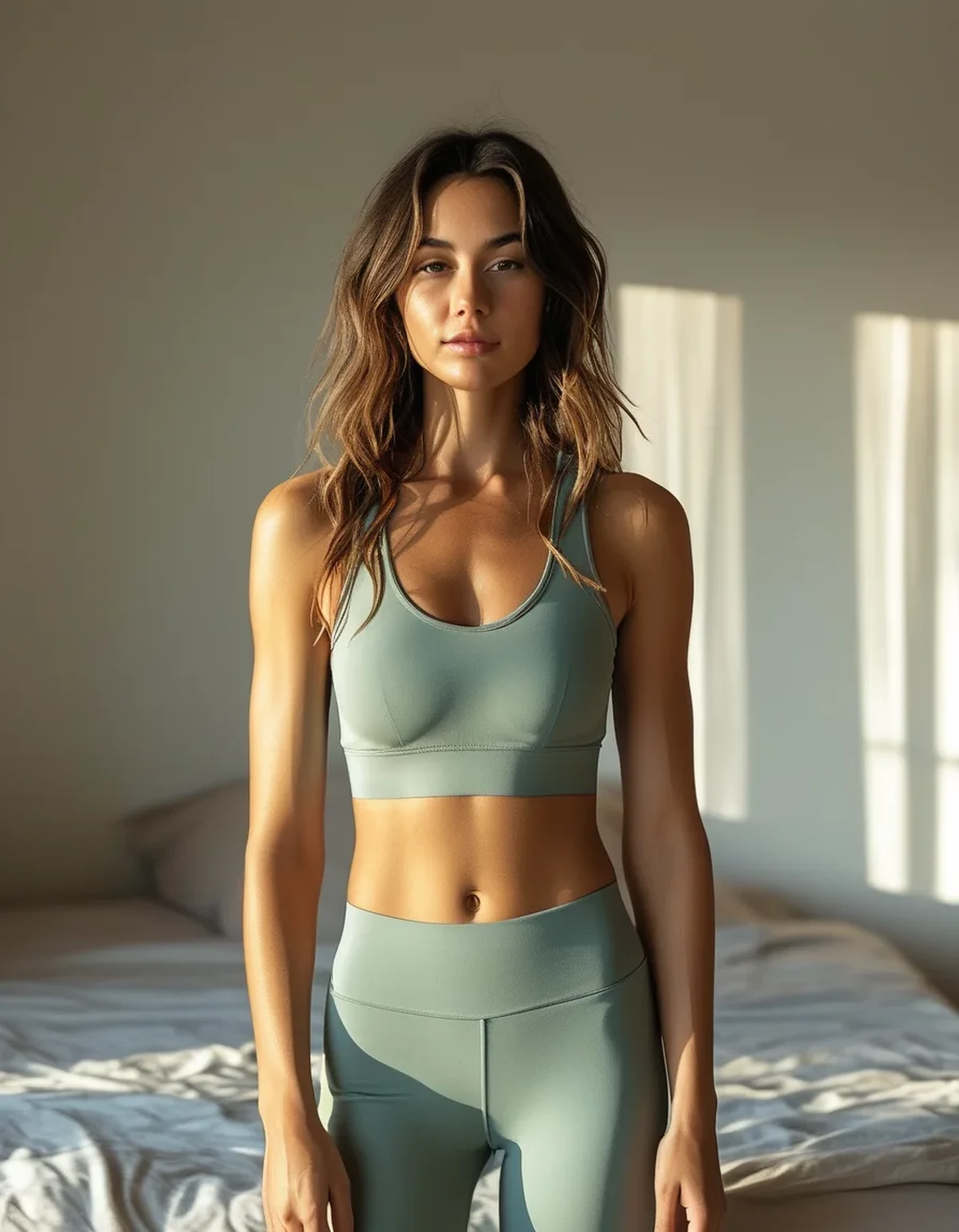
Myth vs Fact: Sizing a Set
Myth: Buying a set in one size is what makes it look coordinated. Fact: what makes it look coordinated is the color and the fabric, both of which are identical across sizes. Nobody can see the label. A well-fitting set in two sizes looks better than a poorly-fitting one in one.
Myth: If one piece does not fit, you sized wrong overall. Fact: this is the assumption the whole problem rests on. Two different garments fitting two different parts of your body have no obligation to be the same number.
Myth: Seamless stretches to fit anyway. Fact: seamless stretches, but the graduated tension zones are placed for a specific size. Stretching a smaller size to fit puts the compression zones in the wrong places — which is why a too-small seamless top can feel tight in an odd, uneven way rather than uniformly snug.
Myth: Sizing up the top gives more comfort. Fact: for seamless tops with any support function, sizing up loses the support without gaining much comfort. If a top is uncomfortable at the correct size, the style is wrong, not the number.
What if the brand only sells sets as a unit?
A few workable approaches, in order of how well they tend to go:
Buy two sets and mix. Expensive, but it produces two well-fitting sets from two poorly-fitting ones if your sizes are one apart and you can return nothing. Some people split the cost with a friend who has the mirror-image problem.
Buy the size that fits the top and wear the leggings at a lower rise. A slightly small legging worn on the hip rather than the waist is often perfectly comfortable, and seamless bottoms handle this better than sewn ones.
Buy the size that fits the bottom and wear the top as a layer. If the top is slightly large, it works over a proper sports bra as a light layer rather than as a support piece.
Contact the brand. Many direct-to-consumer activewear brands will split a set on request even when the website does not offer it. It is worth one email, and the answer is yes more often than people expect.
FAQ: Seamless Set Sizing, Answered
Should I measure myself or go by my usual size?
Measure, every time, for seamless especially. Seamless sizing varies more between brands than sewn activewear does because the tension zones are engineered differently by each manufacturer. Your usual number is a starting guess, not information.
How do I tell if a seamless top is the right size on?
Raise both arms overhead and hold for five seconds. If the hem rides up and stays up, it is too small. Then bend forward at the waist — if it gapes at the chest, it is too large. A correct size does neither. Standing still in front of a mirror tells you almost nothing.
Do sets in different sizes wear out at different rates?
Slightly, and in a predictable direction: the piece under more tension ages faster. If you bought a smaller top for support, expect it to lose recovery before the leggings do. Rotating between two sets, if you have them, evens that out and extends both noticeably.
TL;DR:
- Tops and bottoms are fitted by different measurements, so one size rarely serves both well.
- Seamless has graduated tension zones and less forgiving stretch than sewn garments, which magnifies the mismatch.
- Size to the less-forgiving piece — usually the top — and adjust the other.
- Order both pieces at once to reduce dye-batch mismatch, and prefer saturated colors if matching matters.
- Test a top by raising your arms and bending forward, not by standing in a mirror.
The idea worth letting go of is that a set has to share a number to be a set. The color matches, the fabric matches, and the label is inside the garment. Buying the two sizes your body actually needs is not a compromise on the set — it is the only version of it that fits.
See It in Motion
Seen here: High Waist Embossed Yoga Leggings with Side Pockets — shop it on bubblelime.com
Keep Reading
This article is for general informational and styling purposes only. Fit, sizing, and product availability may vary.