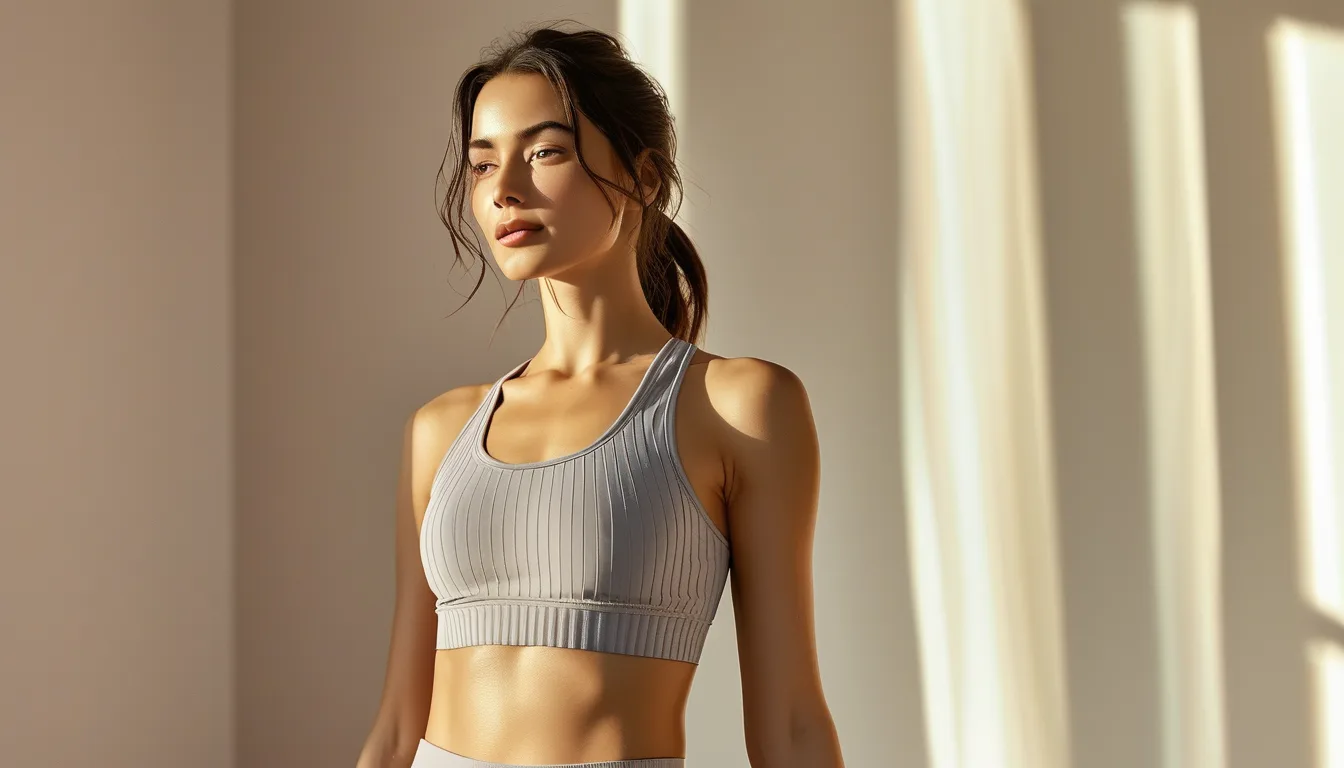
Why a Seamless Set Photographs Completely Differently Than It Looks in the Mirror
Quick Answer: Seamless sets use variable-density ribbed knitting, and ribbing creates fine parallel lines that interact badly with camera sensors and with directional light. Mirrors show you a diffuse, symmetrical, eye-adjusted view; a camera captures a single fixed exposure with one light direction, which exaggerates texture, flattens colour differences between top and bottom, and can produce moire patterning. The set has not changed - the recording method has.
It looked flawless in the mirror and odd in every single photo.
Both images are accurate. They are just measuring different things.
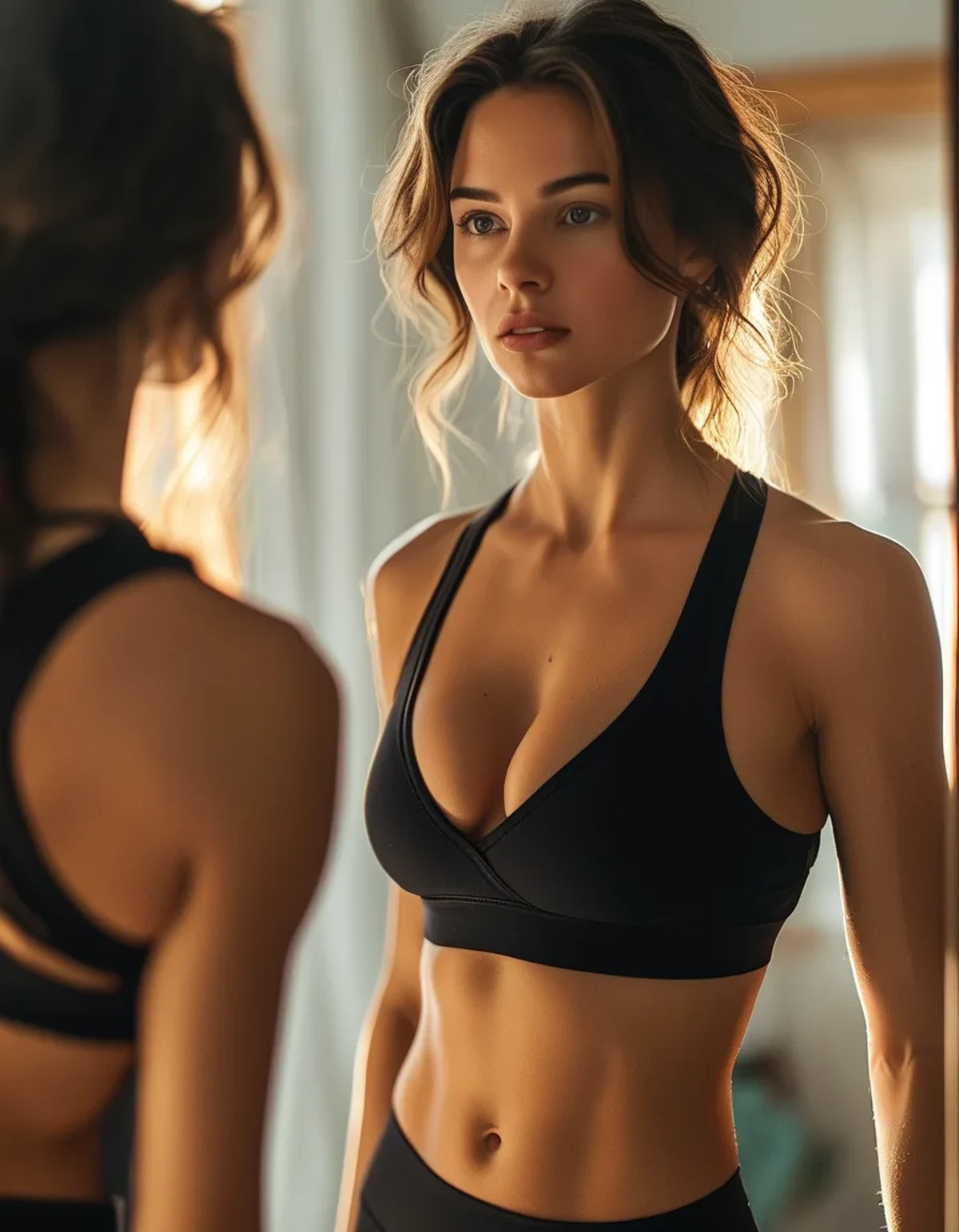
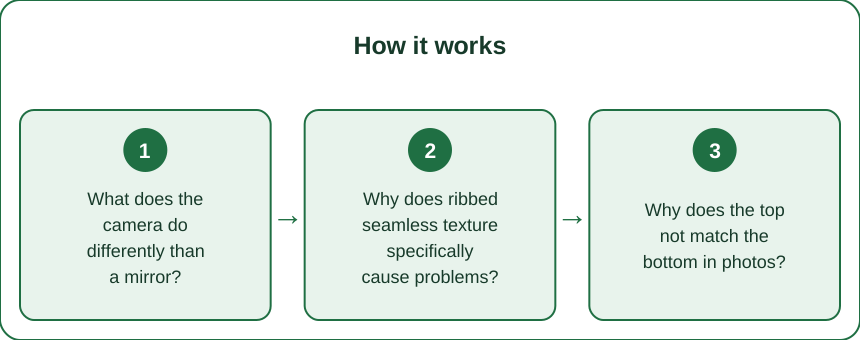
What does the camera do differently than a mirror?
A mirror gives you a live, binocular, continuously adjusting view; a camera gives you a single flat exposure from one point.
Your eyes adapt to local brightness constantly, so you perceive detail in both the bright and shadowed sides of your body. A camera cannot do this within one frame.
Lens focal length changes proportions. Phone cameras at close range have wide-angle characteristics that enlarge whatever is nearest the lens, which is why closer body parts look larger in selfies.
Flash and direct light hit texture head-on, flattening it or exaggerating it depending on angle.
And a mirror image is reversed, which alone makes photographs of yourself look subtly unfamiliar regardless of clothing.
Why does ribbed seamless texture specifically cause problems?
Ribbing is a repeating pattern of fine parallel lines, and repeating fine patterns can interfere with a camera sensor’s pixel grid to produce moire - the shimmering or rainbow effect.
This is a known and unavoidable interaction in fabrics with regular fine structure, and it is worse at certain distances and angles.
Directional light across ribbing creates strong micro-shadows, which makes the texture read far more prominently than it does to the eye.
Light along the ribs flattens it; light across the ribs exaggerates it. So the same set photographs completely differently depending on where you stand relative to a window.
Variable-density knitting means different areas have different rib scales, which is why one part of a set can moire while another does not.
And the top and bottom of a set often have different rib densities by design, which is exactly what makes them photograph as slightly different colours.
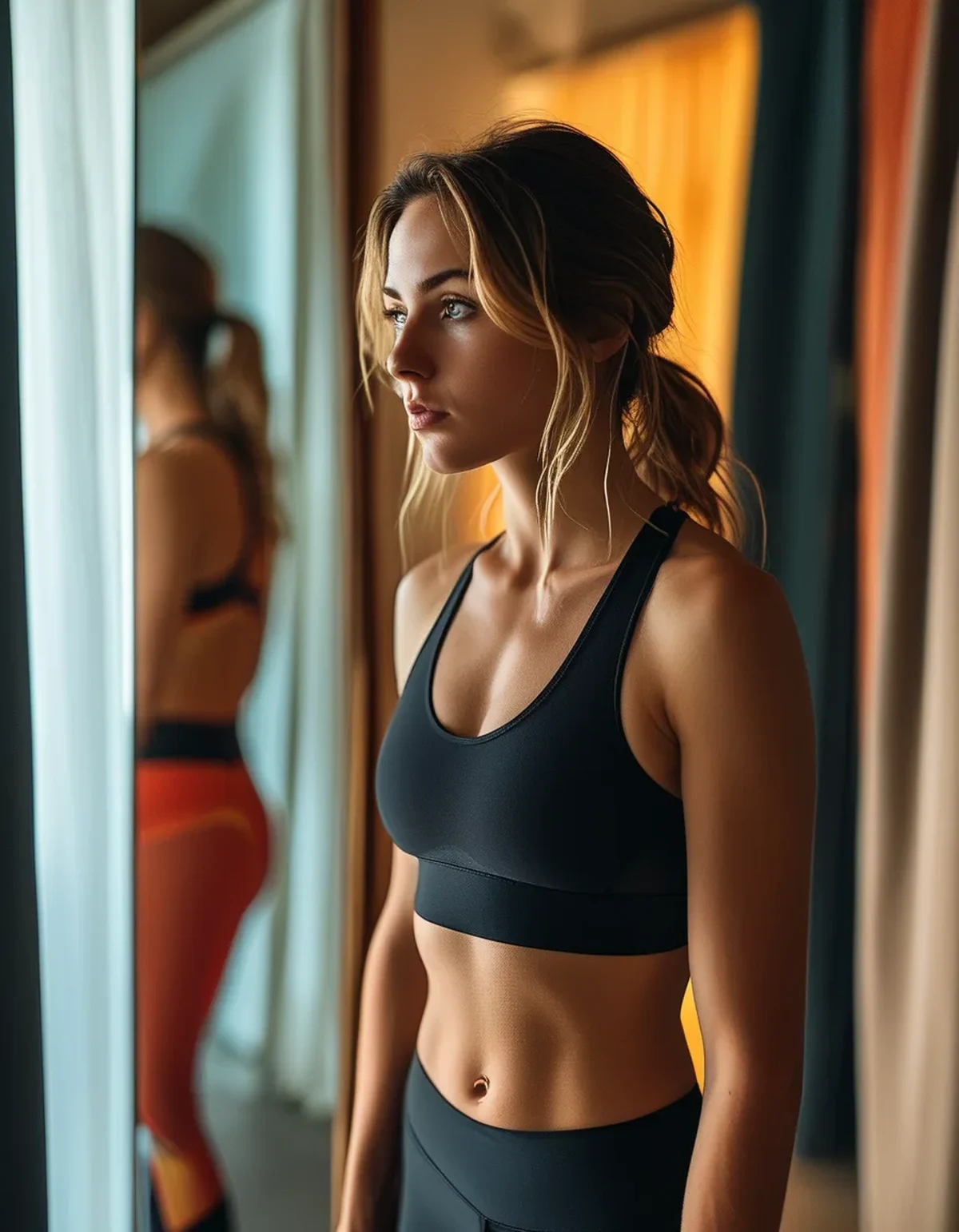
Why does the top not match the bottom in photos?
Perceived colour depends on texture as much as dye. A denser knit reflects light differently than a more open one, so identical dye can read as two shades.
Tops and bottoms are typically knitted at different densities - more support and coverage in the leggings, more breathability in the top.
Your eye compensates for this in person and largely does not in a photograph, where the two areas are recorded under a single fixed exposure.
Different fabric tension over different body curvature changes both the stretch and the apparent colour.
And the top and bottom age at different rates, so a set that started matched can genuinely drift apart after a few months of washing - which shows in photos before it shows in mirrors.
What Nobody Tells You About Photographing Activewear
Side light is the enemy of ribbed fabric and the friend of everything else. Light raking across ribs creates shadow lines that make texture look coarse. If you want the set to photograph as it looks, turn so the light comes from roughly in front or is diffuse.
Step back and zoom in rather than holding the phone close. Distance reduces the wide-angle distortion that changes proportions, and most phone cameras have a longer focal length option that is far more flattering than the default.
Moire is a camera artefact, not a fabric defect. If a set shows shimmering patterning in photos but looks fine to the eye, the fabric is fine. Changing distance or angle slightly usually removes it entirely.
Gym mirror photos combine every difficult factor at once - overhead lighting, a dirty mirror, mixed colour temperature from fluorescent and LED sources, and a close phone. It is close to the worst possible test of whether a set matches.
Colour temperature varies enormously between rooms, and matching between two knit densities is most fragile under mixed lighting. A set that matches in daylight can look mismatched under gym lights and be entirely unchanged.
Phone processing sharpens texture by default, which specifically exaggerates ribbing. Some phones have a setting to reduce this, and it makes a visible difference on knit fabrics.
And the mirror is not more truthful than the camera. Both are limited recordings. The mirror shows adaptive, three-dimensional, live vision; the photograph shows a fixed slice. Judging fit on either alone is judging one incomplete record.
FAQ: Seamless Set Photo Questions, Answered
Why does my seamless set look shimmery in photos?
That is moire - an interference pattern between the fabric’s fine repeating ribs and the camera sensor grid. It is a camera artefact, not a fabric fault, and changing distance or angle usually removes it.
Why does the top look a different shade than the leggings?
Different knit densities reflect light differently, so identical dye can read as two shades. Your eye compensates in person; a single camera exposure does not.
How do I photograph activewear so it looks right?
Diffuse or front-facing light rather than side light, step back and zoom rather than holding the phone close, and avoid mixed lighting sources.
Is the mirror or the camera more accurate?
Neither. The mirror shows adaptive live vision; the photo shows a fixed exposure. Both are partial.
Why do gym mirror photos look worst?
Overhead lighting, mixed colour temperatures, mirror quality and close phone distance all stack up in the same shot.
Does the set actually stop matching over time?
Yes, eventually - tops and bottoms are knitted at different densities and age at different rates, so genuine drift does occur after months of washing.
TL;DR:
- Ribbed seamless knit produces moire with camera sensors - an artefact, not a defect.
- Side light exaggerates rib texture; front or diffuse light shows it as your eye sees it.
- Different knit densities in top and bottom make identical dye read as two shades in photos.
- Close phone distance distorts proportions - step back and zoom instead.
- Gym mirror photos stack every difficult variable at once.
- Neither mirror nor camera is the truthful one; both are partial records.
If it looks right in person and odd in photos, the recording method changed - not the set.
See It in Motion
Seen here: Super High Waist Embossed Yoga Leggings with Inner Pocket — shop it on bubblelime.com
Keep Reading
This article is for general informational and styling purposes only. Fit, sizing, and product availability may vary.