Why Seamless Sets Pill Faster — and How to Slow It Down
Quick Answer: Pilling happens when short surface fibers work loose, tangle, and ball up. Seamless knits pill more because they are made on circular knitting machines using softer, loftier yarn with more exposed fiber ends, and because the ribbed texture creates raised areas that take friction first. Slow it down with cold washes inside out in a mesh bag, no fabric softener, air drying, and rotating pairs so the same fabric is not stressed daily. Remove existing pills with a fabric shaver, never by pulling them off.

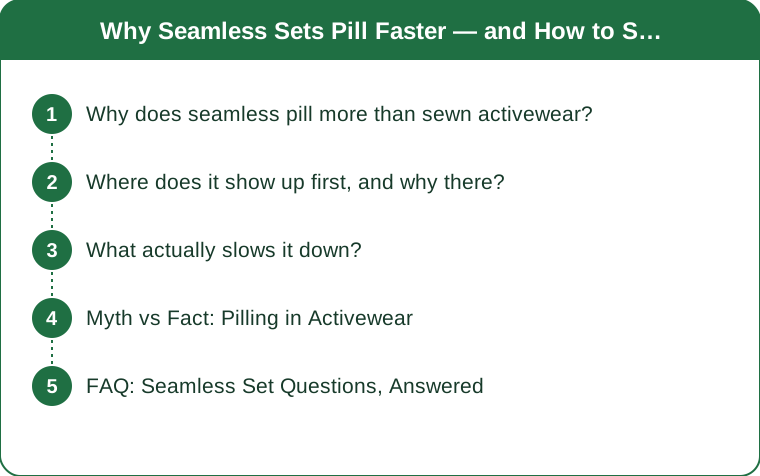
Why does seamless pill more than sewn activewear?
Yarn choice. Seamless garments are knit on circular machines that need yarn with a degree of loft and softness to form the varied stitch structures. That yarn has more protruding fiber ends than the tightly twisted filament yarn used in flat-knit compression fabric. More exposed ends means more material available to tangle.
Surface texture. Most seamless sets use ribbing, mesh zones, or pattern knitting for shaping — that is how they create structure without seams. Those raised areas stand proud of the surface and absorb friction first, concentrating wear in the places you can see.
Lower knit density in the stretch zones. Seamless construction deliberately varies density to create compression where needed and give elsewhere. The looser zones have less structure holding fibers in place.
Synthetic fibers do not shed pills. On a cotton garment, pills form and then break off, because cotton fibers are relatively weak. Polyester and nylon are strong enough that the pill stays attached by a still-intact fiber. That is why synthetic pilling looks worse — it accumulates rather than falling away.
So pilling on a seamless set is a predictable consequence of how it is made, not a sign the set was cheap.
Where does it show up first, and why there?
The inner thigh. Highest friction area in any bottom garment — fabric against fabric with every step. This is universally the first place.
Under the arms and along the bra band. Arm swing plus the band’s contact creates constant rubbing, and the fabric there is often thinner by design for breathability.
Wherever a bag strap sits. A crossbody strap, a backpack, or a gym bag concentrates abrasion in a narrow line. Many people first notice pilling on one shoulder only, which is the giveaway.
The waistband contact zone, where a top’s hem meets a legging’s band and the two rub each other.
The seat, from sitting on textured surfaces — gym benches, car seats, outdoor furniture.
The pattern tells you something useful: pilling is almost entirely mechanical, and it maps directly onto where things rub. That means it is influenced far more by how you wear and wash a set than by what you paid for it.
It also means a set that pills in one specific spot usually has an identifiable cause you can remove — the bag strap being the most common and easiest to fix by switching shoulders or using a different bag.

What actually slows it down?
Wash inside out, cold, in a mesh bag. Inside out puts the visible face away from abrasion. Cold protects the elastane. The mesh bag prevents contact with zippers and rougher fabrics, which are the most common accelerators.
Never wash with towels, denim, or anything with hardware. Terry loops and rivets are abrasive against a soft seamless knit.
Skip fabric softener. It coats fibers and loosens them at the surface, which increases fiber migration — the first step in pill formation.
Air dry. The dryer combines heat with sustained tumbling abrasion. It is the single largest accelerator of pilling in synthetic knits.
Rotate. Fibers need recovery time. A set worn daily is under constant stress and pills faster than one in a rotation of three.
Reduce liquid detergent slightly. Excess detergent leaves residue that stiffens fibers, making them more prone to breaking at the surface.
To remove pills that already exist: use a battery-powered fabric shaver on a flat, unstretched surface. Do not stretch the fabric while shaving, and do not use a razor blade on stretch knit — it cuts intact fibers and creates thin spots.
Never pull pills off by hand. Each pill is attached by a fiber that is still part of the fabric, and pulling it breaks that fiber below the surface, which creates the next pill faster.
Myth vs Fact: Pilling in Activewear
Myth: Pilling means the fabric is cheap. Fact: It correlates far more with yarn type and construction than with price. Premium seamless sets pill; budget flat-knit compression often does not.
Myth: Shaving pills damages the garment. Fact: A proper fabric shaver cuts pills at the surface and does no structural harm. A razor blade, scissors, or pulling by hand does.
Myth: Pilling means the garment is wearing out. Fact: It is a surface phenomenon. A pilled set can be structurally sound with full compression and opacity intact. Thinning is the wear signal; pilling is cosmetic.
Myth: Washing less prevents it. Fact: Wearing causes more friction than washing does. Unwashed activewear also accumulates body oils that degrade elastane, so this trade is a net loss.
Myth: Anti-pill treatments last. Fact: Chemical anti-pill finishes wash out over roughly 20 to 30 cycles. Yarn quality is the durable factor, and it is not something a finish can substitute for.
FAQ: Seamless Set Questions, Answered
Is it worth buying a fabric shaver?
Yes — it is inexpensive and it visually restores sets that otherwise look worn out. It is the highest return-per-dollar item for anyone with several seamless pieces.
Does ribbed seamless pill more than smooth seamless?
Generally yes, since the raised ribs take friction first. The tradeoff is that ribbing provides the structure and stretch that make the set fit well, so it is a feature with a cost rather than a flaw.
Why does my top pill and my leggings do not, in the same set?
Different friction exposure. The top meets bag straps and arm swing; leggings meet inner-thigh contact. If the leggings are unpilled, it is usually because the wear pattern happens to be gentler, not because the fabric differs.
Can I prevent pilling entirely?
No. You can slow it substantially — care habits realistically extend the good-looking phase from a few months to a year or more — but friction on soft synthetic yarn always produces some pilling eventually.
TL;DR:
- Seamless knits pill because they use loftier yarn with more exposed fiber ends and raised ribbed textures.
- Synthetic pills stay attached rather than shedding, which is why they accumulate visibly.
- Wash cold, inside out, in a mesh bag; no softener, no dryer, and never with towels or denim.
- Remove pills with a fabric shaver on unstretched fabric — never pull them off by hand.
- Pilling is cosmetic. Thinning is the actual wear signal.
A seamless set that pills is doing exactly what its construction predicts. Twenty seconds with a shaver and a change of wash habits keeps it looking new far longer.
See It in Motion
Seen here: Super High Waist Embossed Yoga Leggings with Inner Pocket — shop it on bubblelime.com
Keep Reading
This article is for general informational and styling purposes only. Fit, sizing, and product availability may vary.