Why Your Matching Set Stops Matching After a Summer of Washing
Quick Answer: Sets stop matching because the two pieces live different lives: the top meets more sunscreen, deodorant, and direct sun; the bottoms meet more friction and stretch; and — the biggest driver — they get washed on different schedules with different frequency, so their dye loss and fiber wear diverge week by week. Even identical fabric drifts apart under unequal treatment, and sets built from different fabrics for top and bottom start drifting in the store. The fix is treating the set as one garment: bought together, worn as a unit or rotated evenly, washed together cold and inside out, and never dried hot.
Here is why the drift happens, and the routine that keeps a set a set.

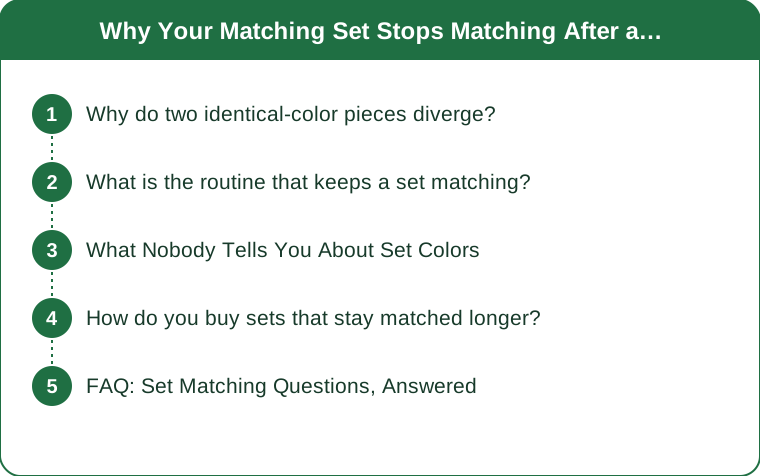
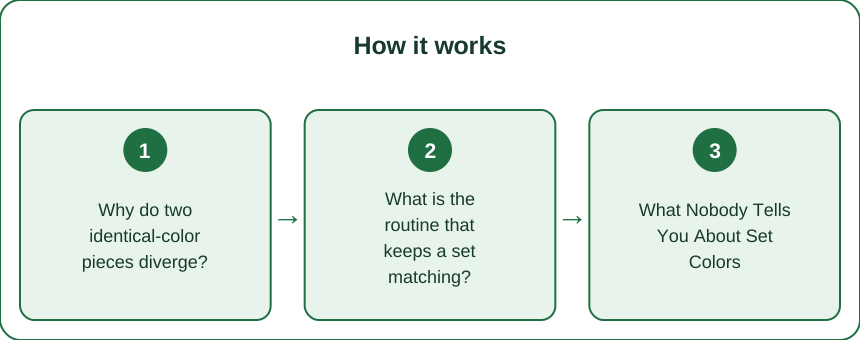
Why do two identical-color pieces diverge?
Because color lives in dye molecules and surface texture, and every wear and wash edits both — unevenly.
Different fabrics were never the same color to begin with. Many sets pair a soft, often modal-blend or lighter-knit top with a compressive nylon-elastane bottom. The same dye recipe lands differently on different fibers, and brands match them optically under store light. Daylight and a summer of washing reveal the compromise: the fibers release dye at different rates, so the match that shipped drifts on schedule. Sets where top and bottom share one fabric — common in a good seamless set — start with the best odds.
Wash frequency is the great divider. Sports bras and tops absorb the sweat event of every workout and get washed after every wear; leggings often serve twice between washes. Run that for a summer and the top has taken half again as many wash cycles — each one a small dye withdrawal and a small fiber-surface roughening. Nothing dramatic happens in any single wash; the divergence is compound interest.
Chemistry hits the top harder. Sunscreen is the summer villain — avobenzone and related filters can react with fabrics and even laundry water minerals into stubborn discoloration, and the top takes the shoulder, chest, and back contact. Deodorant works on the underarms; body oils concentrate at the neckline. The bottoms trade that chemistry for mechanical wear: stretch-whitening at the seat and knees, where strained fibers scatter light paler, and friction sheen where thighs and saddle contact rub.
And sunlight edits whatever is outermost. The top on an outdoor run, the shoulders especially, takes UV that slowly bleaches dye — one reason shoulder fade is the classic tell of an outdoor summer.
None of these forces is optional, but almost all of them are equalizable — which is the entire strategy.
What is the routine that keeps a set matching?
One principle — equal treatment — executed through five habits.
Wash them together, always, even when one seems clean. This is the counterintuitive core: the top needs the wash, the bottoms can skip it, and skipping is exactly how the divergence compounds. A set is one garment that happens to have two hangers; if the top goes in the machine, so do the bottoms. Equal cycles mean equal dye loss means synchronized aging — the pieces fade together, which keeps them matching even as they both soften a shade.
Cold, inside out, gentle, dark-with-darks. Cold water slows dye release dramatically; inside out puts the wash friction on the inner face so the visible surface keeps its finish; the gentle cycle reduces the mechanical rubbing that dulls color fastest. Standard advice, but it is doing double duty here — everything that slows fading also slows drift, because there is less change to diverge.
Never the dryer. Heat is the single fastest ager of both dye and elastane — a hot dryer fades color, cooks stretch, and does it unevenly between two different-weight pieces, since the lighter top cooks faster than the dense bottoms. Hang both, out of direct sun. A set that never meets the dryer stays matched roughly twice as long, and fits better the whole time.
Rinse the chemistry off fast in summer. Sunscreen-and-sweat sitting in a hamper for three days is a slow stain in progress. Sets worn over sunscreen deserve a same-day rinse or wash — and applying sunscreen fully before dressing, with a minute to absorb, cuts the transfer at the source.
Rotate sets as units, not pieces. If you own three sets and mix the pieces freely, each item accumulates a random history and nothing matches anything by October. Keeping pairs married — worn together, washed together, retired together — is what makes a drawer of matching sets stay a drawer of matching sets instead of six near-miss separates.
The payoff compounds exactly like the problem does: nothing visible per week, and in three months the set still photographs as one color while its mixed-history twin reads thrift-flip.

What Nobody Tells You About Set Colors
Some colors are drift-proof by physics. Black and true navy hide early divergence because deep shades have dye to spare and small losses read as slightly-less-black. Heather and marled tones hide it structurally — the color is already intentionally uneven, so drift disappears into the melange. The exposure list runs the other way: saturated brights, dusty pastels, and fashion shades like sage and mauve show every increment, because the eye is exquisitely tuned to small differences between two adjacent midtones.
Matching fails at the boundary. Nobody perceives absolute color; everyone perceives the line where waistband meets hem. A faded set worn with the top tucked or a layer breaking the boundary reads matched again — which is both a styling rescue for a drifted set and an argument that high-contrast sets survive socially longer than tonal ones.
Stretch-whitening is not dye loss and will not wash out. The pale cast at a legging’s seat and knees is strained fiber scattering light — a texture change. Nothing restores it, and it is the reason bottoms can look lighter than the top even when the dye chemistry says otherwise. Buying bottoms with adequate size and squat-tested opacity delays it, since fabric at maximum stretch whitens fastest.
Dye transfer fakes fading. A set washed with new jeans picks up invisible blue haze that shifts its color relative to its partner washed separately — one more argument for the wash-together rule, which at least keeps contamination equal.
Restocked replacements are only mostly the same color. Dye lots vary batch to batch, so replacing just the faded top with a new one often produces a worse mismatch than the fade did — new-bright top over aged bottoms. If a set matters to you, the durable move is replacing it as a pair, or buying the second set up front and rotating both evenly from day one.
How do you buy sets that stay matched longer?
Five checks at purchase that decide most of the outcome before the first wash.
Check the fabric labels on both pieces first. Same fiber content top and bottom is the strongest predictor of synchronized aging — a nylon-elastane top over nylon-elastane leggings drifts far slower than a modal top over nylon bottoms, because identical fibers hold and release dye alike. One-fabric construction is the quiet advantage of many seamless sets, and it is printed right there on the tag.
Prefer deep, dark, or heathered colors for the sets you will wear hardest. Save the sage, lilac, and bright coral for sets in lighter rotation — or accept their shorter matched lifespan as the price of the color. The workhorse set that anchors three workouts a week earns black, navy, espresso, or heather by default.
Squat-test the bottoms in your true size before committing. Fabric living near maximum stretch whitens and sheers earliest — the bottoms that fit with room in the stretch range age slower everywhere. Sizing for longevity and sizing for comfort point the same direction: correct, not smaller. The same logic that applies to any high-waisted leggings applies double to the half of a set that must keep matching its partner.
Buy the pair as a pair, and consider the backup early. Colorways retire fast in activewear; the set you love in April is often gone by August. If a set becomes your uniform, the second identical set — rotated evenly with the first — is the only reliable insurance, since future dye lots will not match your aged pair anyway.
Start the equal-treatment routine from wash one. Drift prevented from the beginning is invisible; drift corrected at month three is a mitigation project. The set that gets cold-washed together, hung together, and never dried hot from its first week is the one still photographing as a matched set at the far end of next summer — which, given what a good matching workout set costs, is the difference between a purchase and a subscription.
And when a favorite set does finally drift past rescue: the pieces are not dead, they are promoted to separates. A softened top over dark bottoms, the aged leggings under a long tunic — the set had a matched life and an unmatched afterlife, and both count.
FAQ: Set Matching Questions, Answered
Can I fix a set that has already drifted apart?
Partially. Equalize their care from today and the gap stops widening; a dye-refresh product in the correct shade can close some distance on solid colors, though results on synthetics are modest and elastane hates hot dye baths. The honest fixes are styling — break the boundary with a layer — or promotion to separates.
Does washing in a mesh bag help with this?
Yes, more than it gets credit for: the bag cuts the friction component of fading for whatever is inside, and putting both pieces of the set in one bag conveniently enforces the wash-together rule. Close the bra hooks first; hooks inside a shared bag are how snags happen.
Are expensive sets more drift-resistant than budget ones?
Often, though the mechanism is specific: better dye fixation, matched-fabric construction, and higher-quality elastane that survives more cycles. But an expensive set dried on hot fades faster than a budget set hung dry — care beats price in this equation, and the combination beats both.
My set matches indoors but looks off outside. Which is real?
Both — store and home lighting flatten color differences that daylight reveals, and some pairs are metameric: dyed to match under one light source only. Judge sets in daylight before buying when you can, and audit your drawer by the window, since daylight is where the mismatch will be seen anyway.
TL;DR:
- Sets drift because the pieces live different lives: tops take more washes, sunscreen, and sun; bottoms take stretch and friction — and unequal treatment compounds weekly.
- The core fix is equal treatment: wash the pair together every time, cold and inside out, hang dry always — heat is the fastest un-matcher there is.
- Buy for longevity: same fabric on both labels, dark or heathered workhorse colors, bottoms sized so the fabric never lives at maximum stretch.
- Rotate sets as married units, rinse sunscreen-soaked pieces same-day in summer, and when drift wins anyway, promote the pieces to separates.
Tonight, pair up the sets in your drawer and make the marriage official — one hanger, one wash bag, one schedule each. The set you equal-treat from this week forward will still be a set next August.
See It in Motion
Seen here: High Waist 8” Yoga Shorts — shop similar styles on bubblelime.com
Keep Reading
This article is for general informational and styling purposes only. Fit, sizing, and product availability may vary.